


Prepared by Dr. Lynn W. Phillips, former award-winning faculty at Stanford Graduate School of Business and on-staff expert in Client Experience Engineering, Berkeley Research Group (BRG).
In a previous post, I introduced PADRE as a Client Experience leader in Alternative Dispute Resolution (ADR) within legal services, founded by Hon. Layn R. Phillips, former U.S. Attorney, former U.S. District Judge and my identical twin. In this post, I outline what I call the customer experience architecture of PADRE, one the nation’s leading firms in resolving complex high-stakes legal disputes—the Client Value Proposition it offers clients and the Value Delivery System that supports its execution excellence.
A way of thinking about the customer experience architecture of PADRE or that of any legal services business is that the client experiences that comprise its Client Value Proposition are the Whats that the enterprise promises to deliver to clients in its target stakeholder communities. This includes law firms, the judiciary, insurers, government agencies and companies—and stakeholders in these communities such as senior leadership, General Counsels, Board Members, Lead Plaintiff institutions, investors, etc.
This architecture must also include the Hows, that is, the discriminating combination of actions that the firm takes to deliver on the promised experiences comprising its value proposition. It is a simple enough task to promise all sorts of idyllic outcomes. But it is another thing entirely to describe precisely how an enterprise will deliver these experiences through its designed Value Delivery System, and by executing on this, give clients confidence it will credibly deliver these outcomes for them better than alternatives. 1
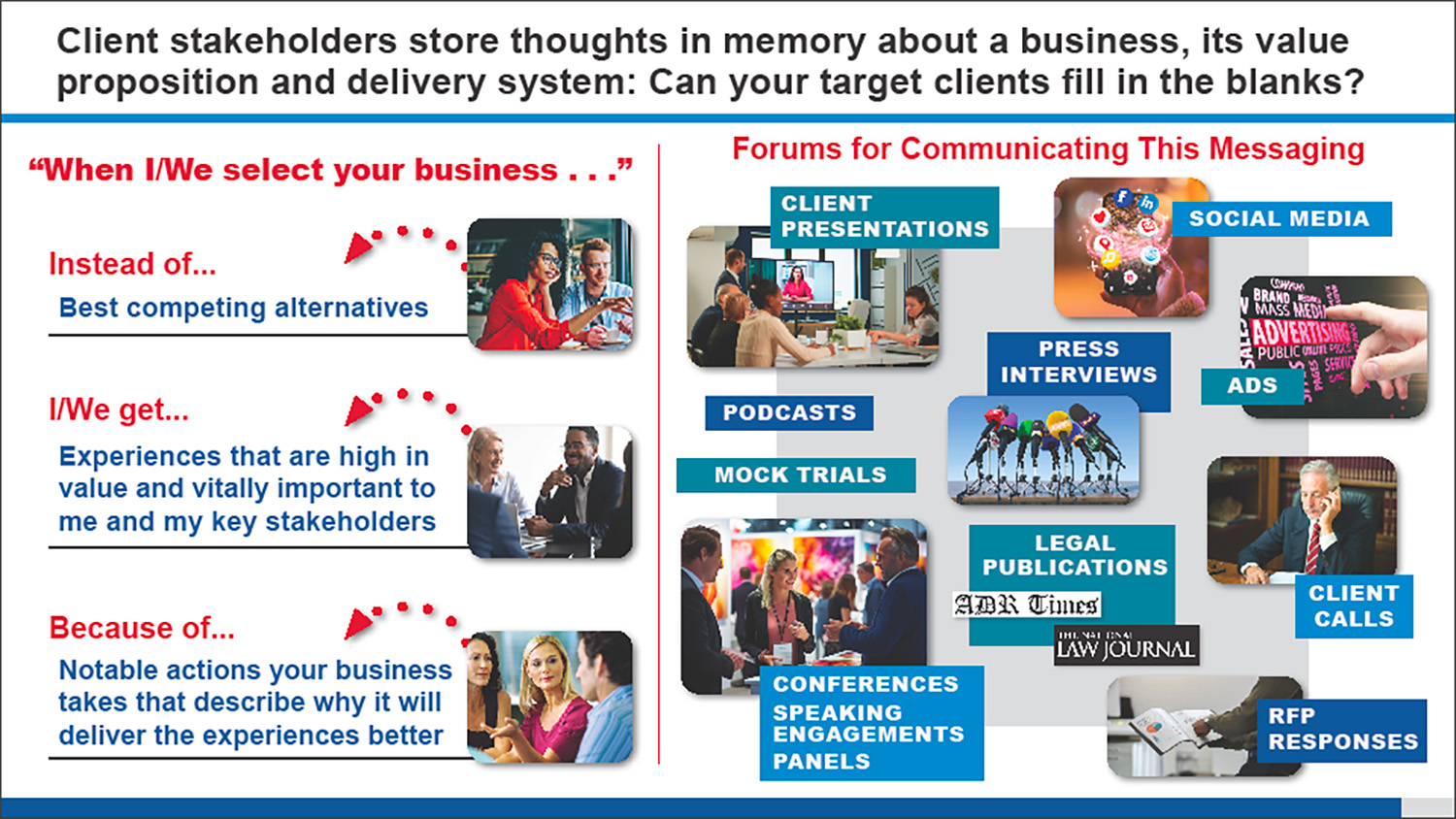
To that end, a business must define the distinctive actions it takes to deliver its proposition. As I’ve written in other Posts, stakeholders store thoughts in their memory about an enterprise, its value proposition and delivery system. Clients should be able to fill-in-the-blanks per the graphic above. If target clients are unaware of the experiences a business delivers that are important to them and the reasons it delivers these better vs. rivals, a business has untapped value from providing more value than it is both communicating or capturing.
For decades, the classic case study illustrating this idea in services was the launch of FedEx. It offered customers shipping rush packages overnight a far more reliable alternative—93% of FedEx packages made it next day vs. 42% with Emory, the leader in freight forwarding at the time, at a price point about 10% cheaper. The consequences for FedEx’s customers were compelling—no disruption in business caused by shipments not arriving in time, plus saved shipping costs, per the graphic below.

This was brilliantly communicated in FedEx’s tagline: “When it absolutely, positively has to be there overnight.” 2
But what really sold the service was the unique Value Delivery System discriminators FedEx put forward. Its novel hub and spoke system with ownership and control over the planes, trucks and offices throughout its network assured customers FedEx would achieve greater reliability vs. rivals whose networks relied on third parties like the passenger airlines to deliver rush packages overnight.
By communicating, “Take away our planes and we’d be like anyone else,” customers could fill in the blanks: “So, if I use FedEx to ship packages overnight instead of Emory, there’s a 93% chance my package gets there next day, more than twice as good as Emory, plus FedEx is 10% cheaper. Why? FedEx controls my package door to door and flies overnight so it arrives sooner and is less likely to be lost in a relay race by disinterested 3rd parties who add their own markup and make me pay more.”
PADRE’s Value Proposition and Delivery System for Resolving Complex, High-Stakes Disputes.
To be memorable like FedEx, a customer experience architecture must be simple in structure, linking the value proposition and delivery system in ways easily understood by stakeholders. PADRE’s does this by promising its target client communities that principles embedded in its delivery model detailed below—a “fierce neutrality” to all constituencies, a focus on “the merits matter” and a “relentless drive toward resolution” to finish what they start—produce stellar outcomes in settling high-stakes disputes:
Clients will reap the immense rewards of avoiding the costs and risks of litigation by traversing a unique, proven, high probability pathway with PADRE to reaching a successful resolution to their dispute in an accelerated time frame—one that all constituencies can own and sell internally to their stakeholders.
This value proposition is recognized by many of the firm’s clients and also by Layn’s former Irell & Manella partners as the unique branded client experience that community stakeholders get by sourcing PADRE as their neutral—as documented in a 2024 article announcing Layn and PADRE’s appointment to serve as the mediator in a recent prominent class action lawsuit. Testimonial excerpts from this publication are shown in the graphic inset on the next page, with a link to similar commentary made by select judges.
While this article featured clients from plaintiff law firms praising Layn and PADRE’s role in the settling of complex, high-stakes disputes, I interviewed defense lawyers for this post who said much the same. The National Academy of Distinguished Neutrals echoed these views in naming Layn its “Neutral of the Year”: “Judge Phillips is on that very short list of U.S. mediators that firms go to when a complex commercial case seems intractable and, time and again, he finds a way to move the parties towards settlement.” 3
Unsolicited commentary on PADRE’s approach to the mediation of complex, high-stakes cases.
Layn was indispensable to resolving the National Football League concussion litigation. He was trusted by both sides and knew exactly where to push and where to let up. He’s one of the very best, top of the game mediators, always on the very short list of mediators called upon to resolve often protracted and very complex cases.
Christopher A. Seeger, Seeger Weiss LLP founding partner who represented former football players in the high-profile National Football League( NFL) concussion case settlement.
This view was echoed by Kellogg, Hansen, Todd, Figel & Frederick PLLC partner David C. Frederick, who also represented retired players in the NFL concussion litigation, who said:
He is that rare person who seems to relish getting in the middle of difficult cases with high stakes and finding palatable solutions to both sides.
David C. Frederick, senior partner at law firm Kellogg, Hansen, Todd, Figel & Frederick PLLC.
Judge Phillips is unique in his ability to distill the most complicated cases down into two or three key issues to focus on at the mediation. Like any good trial attorney, he is able to simplify the issues and focus the parties on the strengths and weaknesses of their case, before transitioning to the numbers.
Mark Molumphy, Cotchett Pitre & McCarthy, LLP who represented 100M consumers in an Apple class action lawsuit.
It’s not often that plaintiffs and defendants agree on anything, but with Judge Phillips, I think that he is largely considered and widely respected as one of the-if not the top-mediators in the space because he’s very effective … at figuring out the substantive strengths and weaknesses of a case
He’s very effective at pushing who he has to push in order to get the parties where they need to go. What [also] makes him effective and why both plaintiffs and defendants seek him out on a regular basis is that he is a very honest broker, and both sides feel that they will get a fair shake with him.
His judicial experience means his recommendations have a lot more weight with the courts. You don’t necessarily get that level of trust from someone who is not a former federal judge. That is very effective in terms of getting settlements approved, which is a very important part of the process.
Laura Posner, Cohen Milstein Sellers & Toll PLLC who was involved in several cases mediated by Judge Phillips.
I don’t think that you are going to find any better mediator in this country That’s why he gets a lot of the biggest cases, the highest-profile cases because he gets results, he settles cases. He was a really great trial lawyer [before becoming a mediator] and he could handle pretty much any kind of case.
He had just the right temperament for being a good mediator and the ability to thoroughly understand parties’ positions, relate to them, know where they’re coming from. But he also had the ability to try to bring parties together by perhaps adjusting their realistic expectations of what their cases were worth.
Michael G. Ermer, Partner Emeritus at lrell & Manella LLP, where Judge Phillips also spent 23 years in practice.
Excerpted from: https://www.law360.com/pulse/articles/1806230/meet-the-ex-judge-mediating-j-j-s-talc-concealment-suit
For commentary by judges echoing these views, see https://phillipsadr.com/about-padre/testimonials/
The PADRE mediation process as practiced by the Hon. Layn R. Phillips (Ret.)
Excerpts taken from: ADR Times interview, 10/10/2022: https://adrtimes.com/whos-who-in-adr-hon-layn-r-phillips/
My mediation process is collaborative, evaluative, and fiercely neutral. Every matter is unique and we treat it as such. We employ a merits-based approach to resolving disputes which requires extensive preparation. This pre-mediation process allows us to approach each mediation individually, rather than a one-size-fits-a/I approach.
I collaborate with my team of mediators, who spend many hours in advance of each mediation absorbing information about the relevant facts, evidence and law, damages assessments, drivers of settlement positions and any other collateral information that helps to focus the issues and lay the groundwork for an effective mediation process.
We work with all parties to understand qualitative factors impacting the value of a case-business considerations, the presiding judge, the track record of rulings and precedent, jurisdiction where the matter is pending, strength and credibility of facts and expert witnesses, and any other related matters.
The baseline process that we typically follow leading up to a mediation involves a pre-mediation process that includes an exchange of pre-mediation briefings by the parties, pre-mediation calls with each of the parties and my team, the issuance of pre-mediation merits questions to each constituency, and the submission and potential exchange of proposed term sheets for settlement.
On the first day of mediation, we typically begin with an a/I-hands session in which we go over the introductions and ground rules. Much of the first day is spent in separate caucus sessions in which the parties are encouraged to candidly discuss with the mediator the claims, defenses, and associated risks. Questions which serve as discussion topics are usually received by parties 2 days before a mediation.
This allows us to push parties in the dispute to help them recognize and assess the risks they face with litigation and understand options for resolution. My trial experience as a judge and advocate helps litigants recognize the risks they face proceeding with litigation vs. resolving the matter at a certain juncture.
I assist and challenge the parties in assessing the strengths and weaknesses of each side’s case and positions, walking the parties through the likely predicted outcome if the case continues in litigation to trial, and working with them to explore and evaluate different settlement options and any alternatives.
If a case doesn’t resolve the first day of a mediation, we employ a process of actively following up with the parties to understand what created the impasse or who is blocking progress and then look for opportunities to break through the impasse and get the parties back to holding productive settlement negotiations.
You may see opportunities to identify and facilitate the exchange of information that helps the parties reach a better understanding about the risks that they and their opponents face, such that they can make a more informed decision about whether to proceed with the litigation or resolve it at a given juncture.
Breakthroughs may come from understanding that one or both parties came to the initial mediation session with an unrealistic expectation of what was achievable. If you listen carefully to the parties, you may notice miscommunications or a lack of understanding that is hampering the parties efforts to reach resolution.
It is often important to explore whether non-monetary terms can add value to a negotiation. Distinguishing the ‘Secretaries of State’ and ‘Secretaries of War’ can lay groundwork for settlement and collaboration. Whatever the issue, a strong follow-on process with parties is key to getting a case back on a path to resolution.
What makes PADRE unique is its ability to tackle these complex, high-stakes disputes which serve as the most “severe-test” of an ADR firm’s capabilities. They are legally and economically intricate, often involving multinational corporations, regulatory agencies, high-profile litigation and press coverage. Resolving them requires a deep understanding of industry undercurrents, negotiation strategies that bridge gaps between opposing parties, and deft management of often complex atmospheric dynamics.
PADRE excels in these environments, consistently delivering outcomes that meet the interests of all the parties. The value of settling these disputes is immense for all stakeholders. Less obvious is how PADRE consistently delivers on its powerful value proposition promise. In a rare interview, Layn, described the process his firm uses in settling complex, high-stakes disputes across all types of matters, per next page inset. Especially noteworthy is the advance preparation by PADRE’s mediators.
But this inset doesn’t tell the whole story. PADRE goes far beyond the background prep that lays the groundwork for an effective mediation described in the inset, using insights from this work to expedite negotiations between the parties. In advance of a scheduled mediation, PADRE neutrals issue hard hitting written, highly tailored, merits-based questions that are submitted separately and privately to all sides for review and consideration. These questions are then used by PADRE as a basis for discussions.
Supplemented by interviews I completed with members of PADRE’s neutral panel who were former clients and had witnessed firsthand Layn’s process at work in helping them to settle their client’s disputes, I derived what I call the 12 Hows by which PADRE delivers its proposition. These are summarized in the inset at the end of this post. It is illuminating to hear from some PADRE neutrals who worked with Layn as former clients and were parties to disputes mediated by him elaborate further on several of these 12 Hows. For example:
While all PADRE’s members of its distinguished panel of neutrals have all-star credentials in resolving complex, high-stakes disputes, most all still “shadow” Layn in 10 mediations, co-mediating with him until they’ve mastered the process. Bill Ohlemeyer, a PADRE neutral with extensive complex dispute experience introduced in post 1 elaborates on how PADRE is growing a team of skilled professionals who embody Layn’s approach to ADR, instilling in them his proven best practice process and tradecraft:
“One of the key competitive advantages of PADRE is that Layn has put together a firm that practices mediation the way he does, which is a proven and phenomenally successful model for settling complex disputes across all types of matters. He is expanding that business model by adding new panel members who can do what he does. When clients hire a PADRE mediator other than Layn, they know how they are going to approach a mediation having been mentored by Layn by shadowing him in multiple mediations.”
 Here too is Sean Coffey on “shadowing”, a PADRE neutral who joined after serving as General Counsel of the U.S. Navy following a career as a renowned trial plaintiffs’ and defense lawyer across diverse complex matters: “Layn mediated a lot of my cases, so I’d seen the process. I’ve now mediated with him and learned a ton. It is very different going with him to each room and talking in between. It’s a richly rewarding experience.”
 Here’s Ann Cook elaborating more on PADRE’s preparation. She joined in 2024 after 10 years as a senior lawyer for global consultancy Ernst & Young (EY), including 2 years as Vice Chair and General Counsel for EY’s U.S. member firm and others in the Americas region. She was responsible for all EY civil litigation and regulatory dockets and advised EY on complex public disclosure issues, client bankruptcy filings, and a host of corporate matters in acquisitions, contracts and governance.
Ann noted that the level of preparation by the PADRE team was unparalleled—the process that they followed and their protocols following up on a mediation—and that this was something that sometimes frustrated her when hiring neutrals from other firms. So, I then asked her, “I guess I’m a little surprised that working hard to prepare for a mediation and following up to help the parties achieve their reason for having one in the first place is a differentiating client experience.” Ann laughed and commented:
“Exactly! It’s often overlooked. Surprisingly, a factor that comes into play when hiring a mediator or arbitrator is, are they willing to work hard on your matter? I once had a mediator tell me they refused to look at any evidence. I was so shocked by this that it has stayed with me for years as an example of what not to do. By digging into the case, I feel that the clients are getting the benefit of a fresh perspective and someone who can give them reactions to their position in a confidential environment.”
“Even if the case doesn’t settle, there is tremendous value to going through the process. No one needs a mediator to just carry numbers back and forth between rooms. If you are hiring a skilled mediator, you deserve someone who has gotten up to speed on the case and adds value. So as a mediator and arbitrator I work hard to understand the case in the way the parties see it. That means staying neutral and hearing what is driving the matter from their perspective. This is a differentiator for PADRE.”
Ann is now 1 of 30 neutrals that illustrate PADRE’s strategic intent to expand capacity to handle an increasing number of high-profile disputes. Their diverse industry sector expertise ensures that there is almost no kind of dispute the firm can’t handle. Clients want neutrals steeped in the ins-and-outs of their industry, its language and contextual nuances, experienced in managing corporate internal and external pressures, and knowing when to tap senior stakeholders and how to safeguard their role and impact.
 Clients also value neutrals with cross-sector expertise who can help them forge creative settlement solutions that transcend what they or their industry peers can imagine. An example is Niki Mendoza, who co-mediated hundreds of cases with Layn and on her own in her 6+ years at PADRE. Her LinkedIn profile details her mediations across diverse industries. She brings a unique perspective as a former litigator and settlement counsel and as a Vice President in a top claims administration firm for class actions and mass torts.
Niki’s views fit my analogy of PADRE as an ADR firm that is playing “mediation rugby,” operating as a tight-knit multidisciplinary team, moving the “scrum” downfield and advancing parties to their goal, while creating a force multiplier in settlement innovation through the firm’s broad sector and legal domain experience: “We are a group of diverse colleagues, each with unique sector and domain expertise, who provide expert support for mediations as needed across every industry and sector and type of case.”
In her interview, she noted, “In cases where it’s just an exchange of numbers, clients will go to any mediator who can facilitate that exchange, whereas PADRE digs into the substance of a case. We’re well-known for our substantial pre-mediation preparation, including written merits questions, and post-mediation follow up. Most parties that attend a mediation are there to try to get something done. We take that task seriously, to either try to settle it at, or shortly following a mediation, to get it on a path to settlement.”
We’ll hear more from Niki and other PADRE neutrals in Part 2, where we take a deeper dive on other of the 12 Hows that make up how the firm discriminates the delivery of its value proposition to clients. Part 2 also addresses a crucial question in the customer experience architecture of any legal services firm, namely: What are the unique experiences that make up the client value propositions of its individual professionals? We will explore this with some vivid examples from members of PADRE’s neutrals panel.
I hope you enjoyed part 1. You can revisit the introduction here. Part 2 will follow next week.
Dr. Lynn W. Phillips • Client Experience Engineering Expert at the Berkeley Research Group (BRG)
PADRE’s Value Delivery System: 12 Hows in Combo Discriminate How it Delivers its Value Proposition:
“Clients will reap the immense rewards of avoiding the costs and risks of litigation by traversing a unique, proven, high probability pathway with PADRE to reaching a successful resolution to their dispute in an accelerated time frame-one that all constituencies can own and sell internally to their stakeholders.”
- Employs merits-based dispute resolution process. • Process is collaborative, evaluative, fiercely neutral. • Honest broker mindset, no plaintiff or defense bias.
- Unmatched level of prep accelerates discussions. • Parties receive written questions on damages, liability. • Used to assess claim values, risks, outcomes at trial.
- Neutrals panel experienced in “severe-test” cases. • Lawyers, GCs, judges who have seen process work. • With backgrounds in high-stakes litigation sectors.
- Neutrals wield deep domain and sector expertise. • Explains complex issues using sector’s language. • Knows sector pitfalls and opportunities inside-out.
- Active, empathetic listeners to each party’s views. • Team works hard to learn each party’s positions. • Earns the trust of parties to represent their views.
- New neutrals mentored via intense “shadowing”. • Neutrals shadow Judge Phillips in 10 mediations. • Sharpens their already honed mediation skillsets.
- Deft timing by neutrals on when and who to push. • Sees the bottom line often before the parties do. • Knows and waits for the “right moment to close”.
- Adroit handling of corporate dynamics & issues. • Neutrals deal with internal and external pressures. • Know how/when to tap input of senior stakeholders.
- Creativity in shaping novel settlement options. • Solutions meet both plaintiff and defendant needs. • Neutrals explore diverse non-monetary solutions.
- Neutral’s career gravitas helps parties to listen. • Conveys shared experiences with the disputants. • Leverages the drawbacks in each party’s case.
- Team works as multidisciplinary diverse “scrum”. • Solution generation taps neutral panel’s expertise. • Creates a force-multiplier in settlement innovation.
- Tenacious follow-up if cases don’t settle on Day 1. • Identifies sources of impasse in the negotiations. • Team approach addresses any snags or issues.
1 Sectors within the industry that have come under scrutiny for not delivering on promised outcomes include the legion of AI startups promising to revolutionize legal practice as well as enterprises involved in consumer litigation financing. See, for example: • McKeen, R. (August 2025). The Legal Tech AI Bubble Is Real and Some Law Firms Will Get Burned. Best Era, JD Supra. https://tinyurl.com/jdsupra-legal-tech-AI • Quallish, P. Esq., Polavin, N. PhD., Metz, D. (February 2024) GoSueMe: The Broken Promises of Third-Party Litigation Funding. IMS Legal Strategies. https://tinyurl.com/imslegal-go-sue-me
2 FedEx “When it absolutely, positively has to be there overnight” – 1979 https://www.youtube.com/watch?v=snQV5eXmUSk

You must be logged in to post a comment.